EMP Preparedness Checklist 2026: Faraday Cage + 72-Hour Plan
A no-hype EMP preparedness checklist for 2026: build a real Faraday cage for under $50, the 7 items that actually belong inside, and a 72-hour action plan you can follow when the grid stops behaving normally.
Most EMP articles spend 80% of their words explaining what an EMP is. This one doesn't. If you want the full background, our EMP Attack Survival Guide covers what an EMP is, the three pulse components (E1, E2, E3), what survives, and what fails.
This guide is the practical follow-on. It assumes you've already accepted EMP as a credible scenario worth preparing for, and you want a clear, step-by-step plan you can actually execute this month. We'll cover three things: a real Faraday cage you can build for under $50, the short list of items that actually belong inside it, and a 72-hour action plan for the day the grid stops behaving normally.
The Core Idea: One Survives, the Rest Don't
You can't EMP-proof your whole life. Hardening every device in a household is impossibly expensive, and most prepper guides that try to imply otherwise are selling something. The realistic strategy is much simpler: pick a small set of high-leverage items, protect them well, and accept that everything else is replaceable.
If you do nothing else from this article, do this: put a spare smartphone, a small solar charger, an emergency radio, and a flashlight inside a sealed metal container in a closet. Total cost: $80 to $200. Total time: an afternoon. That single act covers more of your post-EMP needs than any other purchase you can make.
Everything below is a more thorough version of that same idea.
How to Build a Real Faraday Cage
A Faraday cage is a sealed conductive enclosure that blocks electromagnetic fields from reaching whatever is inside. The principle is simple. The execution has a few details that, if you get wrong, defeat the whole exercise.
The Right Kind of Container
A 30-gallon galvanized steel trash can with a tight-fitting lid is the canonical low-cost Faraday cage. Galvanized steel, not plastic with a metal coating. The seam between the lid and the body is the part most people get wrong: the lid needs continuous metal-to-metal contact all the way around. If yours doesn't sit flush, run aluminum tape around the seam after you close it.
Military ammo cans work well for smaller items. The catch: the rubber gasket inside is non-conductive, which interrupts the seal. Either remove the gasket or wrap a strip of aluminum tape across the lid-to-body seam after closing.
A few options that don't work as well as people think:
- Microwave ovens: Designed to contain a single narrow frequency band, not the broadband energy of an EMP. Don't rely on one.
- Foil-wrapped cardboard boxes: Marginal protection, easily torn, easily missed gaps. Acceptable as an inner layer, never as the only layer.
- Standalone anti-static bags: ESD bags reduce static discharge, not EMP. Use them only as a contact-protection layer inside a real cage.
Insulation and Layering
Items inside a Faraday cage must not touch the metal walls of the cage. Conductive contact creates a path for induced voltage to reach your electronics. Wrap each device in cardboard, bubble wrap, or a non-conductive cloth before placing it in the can.
For your most critical items, use nested protection: wrap the device, place it inside a Mylar bag or smaller metal tin, then place that inside the main cage. Two independent conductive layers separated by an insulator is dramatically more effective than one layer alone.
Testing Your Cage
The cheapest test that catches the most common mistakes:
1. Put a battery-powered FM radio tuned to a strong local station inside the cage.
2. Close it normally.
3. The radio should go silent (or drop to static) before you fully seal the lid.
If the radio still receives a signal with the lid sealed, you have a gap somewhere. Check the seam, replace any non-conductive gaskets with metal-to-metal contact, and retest. A cage that fails the radio test will not protect anything more sensitive than a radio either.
What to Actually Store Inside
The mistake most preppers make with Faraday cages is filling them with so much gear that nothing inside is fully configured or current. A small, ruthlessly curated cage is more useful than a packed one full of half-set-up devices.
Here is the short list, ranked by leverage.
1. A Spare Smartphone with HAVEN Installed and Fully Configured
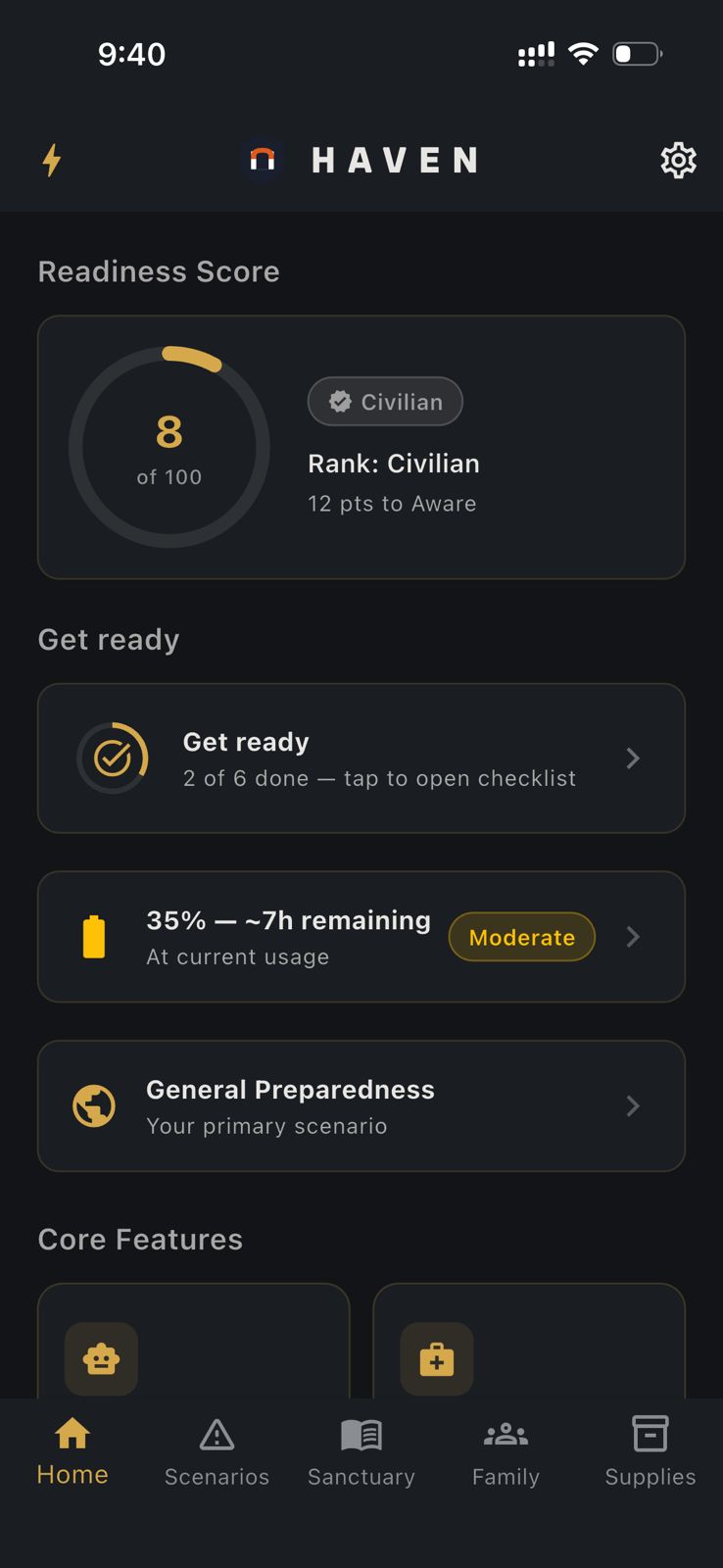
This is the single most important item, and the one most preppers don't think to add. A modern phone with HAVEN configured offline is, functionally, an offline survival reference library, an on-device AI assistant, an offline map of your region, a plant identification tool, and a supply tracker, all in something that fits in a coat pocket.
To set it up properly:
- A used Pixel, iPhone, or mid-range Android with at least 64 GB storage. $80 to $150 secondhand.
- Install HAVEN, activate Pro, download every offline asset (maps, books, scenario packs, AI models).
- Sign no accounts you'll need a password reset for. HAVEN works with no account at all.
- Charge to 80%, power off, place in an anti-static bag, then into the cage.
- Once a year, pull it out, charge it, update HAVEN's offline content, and put it back.
The reason this works is that HAVEN was designed from day one to run completely on-device. No cell signal, no internet, no cloud. After an EMP, when nothing else digital works, this phone still does.
2. Solar Charger and Battery Bank
A small folding solar panel (10 to 28W) with USB output, plus a 10,000 to 20,000 mAh battery bank. The battery bank charges from the panel during the day, and your stored phone charges from the battery bank.
Avoid the very cheapest solar units. Look for ones with both USB-A and USB-C outputs and a real spec sheet. $40 to $80 will get a unit that actually delivers its rated wattage.
3. Emergency Radio
A hand-crank radio with NOAA weather band, AM/FM, and a USB output that can do double duty as a backup phone charger. After an EMP, broadcast radio is one of the few things likely to come back online quickly. Government and commercial AM/FM stations have hardened their critical infrastructure precisely because of this scenario.
4. Two-Way Radios for Family
A pair of FRS/GMRS handhelds covers in-town family coordination. They will not reach across counties, but they will reach across your neighborhood, which is what matters in the first 72 hours. Add a basic ham radio if anyone in the household holds (or is willing to study for) a Technician license.
5. Lighting
A pair of headlamps and a couple of small flashlights, plus a stash of fresh lithium AA and AAA batteries. Lithium primaries hold charge for 10+ years and don't leak the way alkalines do.
6. Storage and Documents
A USB drive with scanned copies of IDs, insurance policies, medical records, prescription lists, deed/title, and family photos. Encrypted with a passphrase you can actually remember. Useful even outside an EMP scenario.
7. Optional: Spare Vehicle Electronics
Only relevant if you depend on a specific vehicle and have access to its critical control modules. A spare ECU, ignition module, and fuel pump relay for the one vehicle you'd use to leave in an emergency. Most households can skip this.
That's the list. Resist the urge to fill the rest of the cage with things you might use someday. A small, well-curated cage that you actually maintain is worth ten cages full of forgotten gear.
The 72-Hour Action Plan
If an EMP event occurs, your first three days set the trajectory of everything that follows. You won't have official confirmation. Cell networks, internet, and TV will all be down at once, which is also true of a major regional power failure or a cyberattack on the grid. The good news is that the first 72 hours of response look almost identical regardless of the cause.
Hour 0 to 1: Assess and Stage
The signature signs of an EMP event are simultaneous failures across unrelated systems: cars stop running mid-drive, every digital device in your house is dead at once, the lights are out, and there is no cell signal. A normal blackout doesn't disable cars or wristwatches.
If the pattern matches:
- Get to your Faraday cage. Open it, retrieve the spare phone and radio. Leave the cage open in a safe interior space; you no longer need to protect what's inside.
- Power on the radio. Scan AM and FM bands for any active broadcasts. Government emergency broadcasts will lead the response.
- Power on the spare phone. Confirm HAVEN is running. Pull up your offline map.
Hour 1 to 6: Lock Down Resources
Before the situation becomes obvious to everyone else, you have a quiet window to secure resources that will become contested fast.
- Fill every bathtub, sink, and large container with water while municipal pressure still holds. Most water systems can run on residual pressure for 6 to 24 hours after pumps lose power.
- Inventory food in the refrigerator and freezer. Plan to eat refrigerated items first, frozen items second, shelf-stable items last.
- Account for everyone in the household. Walk to neighbors who may need help (elderly, parents of small children).
- Switch to manual locks. Most modern garage doors have a manual release. Use it. Pull-cord starts on lawn equipment may help neighbors.
Hour 6 to 24: Stabilize and Triage
Now that you're past the immediate scramble, the work is preventing problems before they happen.
- Designate one room as the climate-stabilized room. In summer, the basement; in winter, the most insulated interior room. Move sleeping there if outside temps are extreme.
- Use HAVEN's supply tracker to map exactly how many days of water and food you have for your household size. Set a daily ration and stick to it from day one. Don't wait until you're running low to start rationing.
- Establish radio check-ins on FRS/GMRS with any nearby family or neighbors who have radios. Pick a channel and a schedule.
- Use HAVEN's AI to walk through any specific medical or supply concerns you have for your household: medications that need refrigeration, infants and formula, anyone with a chronic condition.
Hour 24 to 72: Plan the Next Two Weeks
By 72 hours in, you'll know whether outside services are returning quickly or if this is the long-duration scenario.
- Begin secondary water sourcing. Rainwater collection if it's raining. Surface water that can be filtered and boiled. Conserve aggressively.
- Coordinate with neighbors on shared problems: security, cooking on shared fuel, sharing skills. Community resilience is a real advantage in extended scenarios.
- Use HAVEN's offline scenario guides for whichever specific situation you're in. Each scenario has step-by-step protocols designed to be readable when you're stressed and tired.
After 72 hours, you're operating on whatever you have and whatever you can find or barter. The decisions you made in the first three days, especially around water and rationing, determine how the next month goes.
A Realistic EMP Preparedness Checklist
Walk through this list and check what you have. Anything missing is a candidate for next month's preparedness work. The list is ordered roughly by leverage, with the highest-impact items first.
This Week
- Build or buy a galvanized trash-can Faraday cage and test it with the radio test.
- Install and configure a spare phone with HAVEN Pro and full offline content. Place it in the cage.
- Add a solar charger, hand-crank radio, two FRS/GMRS handhelds, and headlamps to the cage.
- Print a family contact list, the address of one out-of-state contact, and your insurance and medical info. Store paper copies in a waterproof bag.
Within 30 Days
- 14 days of water (1 gallon per person per day, minimum) plus a manual filter (Sawyer Squeeze, Berkey, or equivalent).
- 30 days of shelf-stable food that you actually eat. Rotate it.
- A real first-aid kit with a tourniquet, hemostatic gauze, and a 90-day supply of any prescription medications anyone in the household depends on.
- A non-electric way to cook: propane camp stove with fuel, rocket stove, or cast iron over fire. See our off-grid cooking guide for the full setup.
- Multiple fire-starting methods: lighters, ferro rod, waterproof matches.
- Cash in small bills, kept somewhere a thief wouldn't think to look first.
Within 90 Days
- Expand to 30 days of water capacity (rainwater collection, well backup, or larger storage).
- Expand to 90 days of food.
- Build a basic medical reference library, including HAVEN's offline wilderness medicine content.
- Take a Stop the Bleed course and a basic CPR/AED course.
- Walk an evacuation route from your home with a paper map. Identify three plausible destinations.
Within a Year
- Solar power for at least basic loads (lighting, charging, small fridge).
- Get an amateur radio Technician license. The test is easy and the skill compounds.
- Plant a small garden, even a single raised bed, so you've practiced once before you need to.
- Identify a rural retreat or pre-arranged location if you live in a dense urban area.
Skills That Outweigh Gear
Gear can be lost, broken, or stolen. Skills cannot. The list of skills worth more than any single piece of gear:
- Land navigation with map and compass.
- Wilderness first aid through hands-on training, not just reading.
- Basic mechanical repair on your specific vehicle.
- Food preservation: canning, smoking, dehydrating.
- Fire-making without matches.
HAVEN's offline AI and Sanctuary library cover most of these in reference form, but reading is not the same as doing. Use HAVEN to study before you need to act, and put the skills into practice in low-stakes settings.
Why a Stored HAVEN Phone Is the Highest-Leverage Item
It's worth being specific about why a configured spare phone with HAVEN earns the top of the list, and not just because we built HAVEN.
After a major EMP, the most expensive thing in the post-event environment is information. You can't Google. You can't call a doctor. You can't look up "how to splint a femur" or "how much fuel does a 2,500-watt inverter need" or "is this plant safe to eat." The internet is the single largest practical loss in the first weeks.
A working phone with HAVEN restores most of that. The on-device AI answers natural-language questions. The offline library has 19 illustrated reference books. The maps work without a cell signal. The supply tracker doesn't need the cloud. None of it requires connectivity, and none of it stops working because servers are down.
The cost to add this to your preparedness is roughly the cost of a single restaurant dinner. The information you preserve is worth orders of magnitude more.
Final Note
EMP preparedness has a reputation for attracting catastrophists. It doesn't have to. Most of what's on the list above is good preparedness for any extended grid-down scenario: ice storm, regional cyberattack, hurricane aftermath, civil disruption. You don't need to believe an EMP is the most likely scenario to find this checklist worth doing. You just need to want a household that holds up if any one of those events happens.
A galvanized trash can. A spare phone with HAVEN. A solar charger and a radio. Water, food, a first-aid kit, and a 72-hour plan you've actually walked through. That's the whole thing. Spend an afternoon and a weekend, and you're done with the bulk of it.
Then put it in a closet and forget about it, until the day you don't need to.
FAQ
Q: What is the fastest EMP prep win?
A: A tested Faraday enclosure plus a spare phone preloaded with HAVEN and offline assets, alongside hand-crank radio and FRS radios.
Q: Does turning off electronics guarantee EMP survival?
A: No—long conductors and antennas can still couple damaging energy; shielding beats power state alone.
Q: Is EMP prep different from general blackout prep?
A: Much overlaps—water, food, medical, manual cooking—but EMP adds electronics preservation and spare simple tools.
Q: Why store paper copies of critical info?
A: Digital backups fail if every screen is damaged; waterproof paper lists survive for comms and insurance.
Ready to get prepared?
Download HAVEN free and start your preparedness journey today.