How to Store Food Long Term in 2026: Methods, Shelf Life & Food List
How to store food for long term storage in 2026: when to use Mylar + oxygen absorbers, vacuum sealing, canning, or freeze drying, plus a complete shelf-life list and a budget-aware build plan.
Most "long term food storage" guides give you a list of foods and call it done. This one focuses on the part that actually determines whether your pantry holds up: the methods. Mylar with oxygen absorbers, vacuum sealing, water-bath and pressure canning, and freeze drying each work for a different category of food. Use the wrong method and your beautifully stocked pantry rots, oxidizes, or grows botulism. Use the right one and a 50-pound sack of rice from this year is still good 25 years from now.
This is the comprehensive guide. We cover both sides: the methods that determine whether your storage actually holds up, and the complete shelf-life list you'll use to decide what to buy. If you want a faster overview of foods alone, the [25+ foods that last 25+ years](#a-complete-long-term-food-storage-list-with-shelf-lives) section below has the food list with realistic shelf lives in one place.
Why Long Term Food Storage Matters
The average American household has less than a week's worth of food on hand. That's not a survival strategy, that's a vulnerability.
Consider these scenarios:
- Natural disasters: Hurricanes, earthquakes, and wildfires can cut off supply lines for weeks.
- Economic disruption: Hyperinflation, banking failures, or currency crises can make cash worthless overnight.
- Grid collapse: A prolonged power outage means no refrigeration and no way to buy food.
- Pandemic lockdowns: We saw in 2020 how quickly shelves can empty when fear spreads.
- Personal emergencies: Job loss, medical crisis, or family emergency can make every dollar count.
Long term food storage isn't about paranoia. It's about resilience. It's the difference between being a victim of circumstances and being prepared for them.
How to Store Food for Long Term Storage: The Core Principles
Before we dive into the specific methods, let's establish the four enemies of long term food storage:
1. Oxygen: Causes oxidation, which degrades fats and reduces nutritional value.
2. Moisture: Promotes mold, bacteria, and spoilage.
3. Light: Breaks down vitamins and accelerates degradation.
4. Heat: Speeds up all chemical reactions that cause food to spoil.
Every storage method we discuss is designed to eliminate or minimize these four factors. Master these principles, and you'll understand why certain techniques work, not just what to do.
Method 1: Mylar Bags with Oxygen Absorbers
This is the gold standard for long term food storage. When done correctly, mylar bags with oxygen absorbers can preserve dry goods for 25+ years.
What You Need
- Mylar bags: Food-grade, 5-7 mil thickness. Thicker bags provide better protection.
- Oxygen absorbers: Measured in cc (cubic centimeters). Use 300cc absorbers for 1-gallon bags, 2000cc for 5-gallon buckets.
- Heat sealer or flat iron: To create an airtight seal.
- 5-gallon food-grade buckets: Optional but recommended for additional protection against pests and physical damage.
The Process
1. Choose your food: Only store dry goods with less than 10% moisture content (grains, beans, rice, pasta, flour, sugar, powdered milk).
2. Prepare your workspace: Work in a low-humidity environment. Have all materials ready.
3. Fill the bag: Leave 3-4 inches at the top for sealing. Don't overfill.
4. Add oxygen absorbers: Work quickly. Absorbers start working immediately once exposed to air.
5. Remove excess air: Press out as much air as possible from the bag.
6. Seal the bag: Use a heat sealer or flat iron to create a continuous seal across the entire top.
7. Check the seal: The bag should feel tight like a vacuum-sealed package within 24-48 hours as the absorber removes remaining oxygen.
8. Store in buckets: Place sealed mylar bags inside food-grade buckets for pest protection and stackability.
Pro Tips
- Label everything with contents and date packed.
- Store oxygen absorbers you're not using in a mason jar with the lid sealed tight.
- If the bag doesn't feel vacuum-tight after 48 hours, the seal failed. Repack with a new absorber.
Method 2: Vacuum Sealing
Vacuum sealing removes air mechanically rather than chemically. It's faster and easier than mylar bags, but it has limitations.
Best For
- Medium-term storage (1-5 years)
- Foods with some moisture content (dried fruits, jerky, dehydrated meals)
- Freezer storage
Limitations
- Vacuum bags are not oxygen-proof like mylar. Small amounts of oxygen permeate through over time.
- Not ideal for foods with sharp edges (pasta, rice) that can puncture bags.
- Requires a vacuum sealer machine.
When to Use Vacuum Sealing vs. Mylar
A simple decision rule:
- 25+ year pantry staples: Mylar bags with oxygen absorbers.
- 1-5 year rotation stock: Vacuum sealing.
- Freezer storage: Vacuum sealing.
- Powders and fine grains (flour, powdered milk, cornmeal): Mylar bags only, because vacuum sealing tends to pull powder into the seal and ruin it.
Method 3: Canning (Pressure and Water Bath)
Canning is the best method for preserving wet foods: fruits, vegetables, meats, and prepared meals.
Water Bath Canning
- Suitable for: High-acid foods (fruits, pickles, jams, tomatoes with added acid)
- Shelf life: 1-2 years
- Process: Submerge sealed jars in boiling water for the specified time.
Pressure Canning
- Suitable for: Low-acid foods (vegetables, meats, soups, beans)
- Shelf life: 2-5 years
- Process: Process sealed jars at high pressure (10-15 PSI) to reach temperatures that kill botulism spores.
Critical safety note: Low-acid foods MUST be pressure canned. Water bath canning does not reach temperatures high enough to kill Clostridium botulinum. This is non-negotiable.
Method 4: Freeze Drying
Freeze drying removes 98-99% of moisture while preserving taste, texture, and nutrition better than any other method.
Advantages
- Longest shelf life: 25-30 years for properly stored freeze-dried foods.
- Retains nutrition: Preserves vitamins and enzymes that heat-based methods destroy.
- Quick rehydration: Foods reconstitute in minutes with water.
- Lightweight: Perfect for bug-out bags and portable supplies.
Disadvantages
- Cost: Home freeze dryers cost $2,000-$5,000.
- Time: Each batch takes 24-48 hours.
- Electricity: Requires consistent power during the freeze-dry cycle.
For most preppers, purchasing commercially freeze-dried foods is more practical than investing in a home unit.
The Complete Long Term Food Storage List
This list is organized by category and includes estimated shelf life when stored properly in mylar bags with oxygen absorbers in a cool, dark location.
Grains and Starches (25-30+ years)
- White rice (brown rice only lasts 1-2 years due to oil content)
- Hard red wheat berries
- Hard white wheat berries
- Soft wheat berries
- Oats (rolled or steel-cut)
- Corn (dried kernels, popcorn)
- Barley
- Buckwheat
- Quinoa
- Millet
- Pasta (egg-free varieties last longer)
- Flour (white flour lasts longer than whole wheat)
- Cornmeal
Legumes (25-30+ years)
- Pinto beans
- Black beans
- Kidney beans
- Navy beans
- Great Northern beans
- Lentils (red, green, brown)
- Split peas
- Chickpeas (garbanzo beans)
- Lima beans
- Black-eyed peas
Proteins (5-25 years depending on type)
- Freeze-dried meat (25+ years)
- Canned meat (5-10 years)
- Textured vegetable protein/TVP (10-15 years)
- Powdered eggs (5-10 years)
- Peanut butter powder (5 years)
- Jerky (1-2 years vacuum sealed)
- Canned tuna/salmon (5 years)
- Dried fish (1-2 years)
Dairy and Alternatives (10-25 years)
- Powdered milk (non-fat lasts longest: 25 years)
- Powdered butter (5-10 years)
- Powdered cheese (10-15 years)
- Powdered eggs (5-10 years)
- Evaporated milk (2-5 years canned)
- Condensed milk (2-5 years canned)
Fruits and Vegetables (10-25 years)
- Freeze-dried fruits (25+ years)
- Freeze-dried vegetables (25+ years)
- Dehydrated fruits (10-15 years)
- Dehydrated vegetables (10-15 years)
- Canned fruits (2-5 years)
- Canned vegetables (2-5 years)
- Fruit leather (1-2 years vacuum sealed)
Fats and Oils (2-10 years)
- Coconut oil (2-5 years, longer if refined)
- Olive oil (2-3 years)
- Vegetable shortening (5-10 years)
- Ghee (5+ years if shelf-stable)
- Lard (properly rendered: 3-5 years)
Note: Fats are the hardest category to store long term. Rotate these more frequently.
Sweeteners (Indefinite to 30 years)
- White sugar (indefinite)
- Honey (indefinite, may crystallize but never spoils)
- Maple syrup (indefinite if sealed)
- Molasses (10+ years)
- Corn syrup (indefinite)
- Powdered drink mixes (5-10 years)
Seasonings and Flavor (5-25 years)
- Salt (indefinite)
- Baking soda (indefinite)
- Baking powder (5-10 years)
- Yeast (vacuum sealed: 2-5 years; frozen: 10+ years)
- Dried herbs and spices (2-5 years for best flavor)
- Bouillon cubes (5-10 years)
- Soy sauce (3-5 years unopened)
- Vinegar (indefinite)
- Vanilla extract (indefinite)
Comfort and Morale Foods
Never underestimate the psychological value of comfort food during a crisis:
- Coffee (vacuum sealed: 2-5 years; freeze-dried: 25 years)
- Tea (5-10 years)
- Hot cocoa mix (5-10 years)
- Hard candy (5+ years)
- Chocolate (1-2 years; cocoa powder lasts 10+ years)
- Jell-O and pudding mixes (5-10 years)
- Popcorn kernels (indefinite)
Optimal Storage Conditions
Even perfectly sealed food will degrade if stored incorrectly. Follow these guidelines:
Temperature
- Ideal: 50-60°F (10-15°C)
- Acceptable: 60-70°F (15-21°C)
- Avoid: Above 75°F (24°C). Shelf life drops dramatically.
For every 10°F increase above 70°F, shelf life is cut roughly in half.
Humidity
- Ideal: Below 15% relative humidity
- Acceptable: Below 60% relative humidity
- Avoid: Damp basements, garages in humid climates
Light
- Ideal: Complete darkness
- Acceptable: Indirect light only
- Avoid: Direct sunlight or fluorescent lighting
Location Options
- Best: Climate-controlled basement or interior closet
- Good: Pantry, spare bedroom closet
- Acceptable: Garage (in mild climates with temperature-stable storage containers)
- Avoid: Attics, outdoor sheds, any location with temperature extremes
Tracking Your Food Storage with HAVEN
Here's the hard truth: even the best-stocked pantry is worthless if you don't know what you have, how much you have, and when it expires.
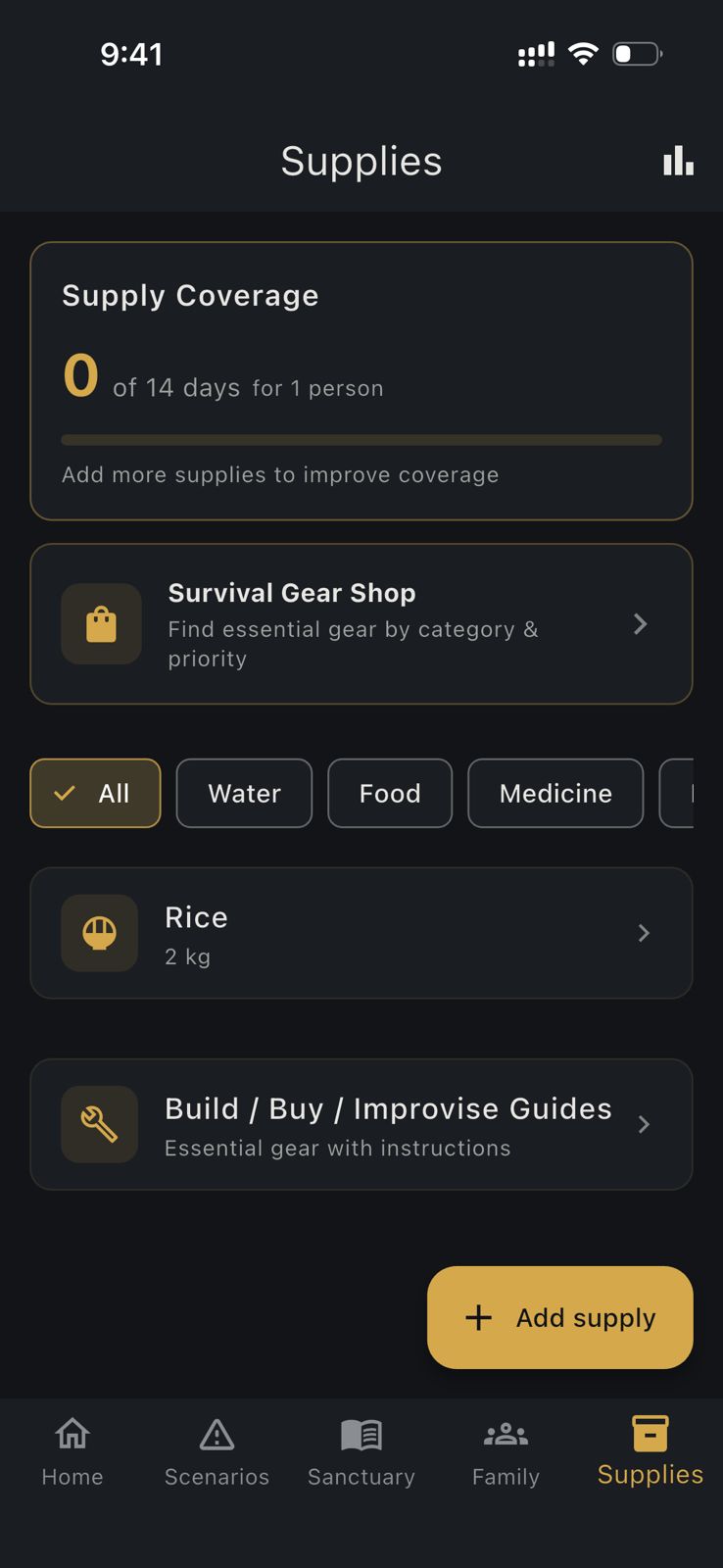
The HAVEN app solves this with the Bug Out Bag & Supplies tracking feature. Here's what it does:
Coverage Day Tracking
Enter your food supplies, and HAVEN calculates how many days of coverage you have for your household. It accounts for household size and shows you at a glance whether you're prepared for 30 days, 90 days, or a full year.
Expiry Alerts
Every item you log can include an expiration date. HAVEN sends you alerts before items expire so you can rotate stock and avoid waste. No more discovering that your entire bean supply expired two years ago.
Category Breakdown
HAVEN organizes your supplies by category (food, water, medical, gear) so you can see gaps in your preparedness at a glance. Maybe you have 6 months of grains but only 2 weeks of protein. The app makes imbalances obvious.
Offline-First Design
Because HAVEN runs entirely on-device, your supply data is always accessible, even during the exact crisis you're preparing for. No internet required. No cloud dependency. Your data stays on your phone.
How to Get Started
1. Download HAVEN from the App Store or Google Play.
2. Navigate to the Supplies section.
3. Start logging your long term food storage items with quantities and expiration dates.
4. Review your coverage days and identify gaps.
5. Set expiry alerts so nothing goes to waste.
Building Your Long Term Food Storage: A Practical Timeline
Month 1: Foundation
- Buy 50 lbs of white rice and 25 lbs of beans.
- Purchase mylar bags, oxygen absorbers, and 5-gallon buckets.
- Pack your first batches and store properly.
- Download HAVEN and log everything.
Month 2-3: Expand Staples
- Add wheat berries, oats, and pasta.
- Stock up on salt, sugar, and honey.
- Begin a canned goods rotation system.
Month 4-6: Diversify
- Add freeze-dried fruits and vegetables.
- Stock protein options: canned meat, TVP, powdered eggs.
- Include comfort foods: coffee, tea, cocoa.
Month 6-12: Complete and Maintain
- Fill gaps identified by HAVEN's category tracking.
- Establish a rotation schedule for shorter-shelf-life items.
- Test your storage by cooking meals from your supplies.
Common Mistakes to Avoid
1. Storing food you don't eat: If your family hates beans, don't store 200 lbs of them. Store what you'll actually eat.
2. Ignoring rotation: Long term doesn't mean "set and forget." Rotate stock, especially oils and shorter-shelf-life items.
3. Skipping the oxygen absorbers: Mylar bags alone don't remove oxygen. The absorbers are essential.
4. Storing in temperature extremes: A garage in Phoenix or an attic anywhere will destroy your supplies.
5. Not tracking inventory: If you don't know what you have, you can't use it effectively. Use HAVEN.
Final Thoughts
Long term food storage is an investment in your family's security. It takes time, money, and effort upfront, but the payoff is concrete: a household that can absorb supply chain disruptions, natural disasters, or just a bad month, without panic at the grocery store.
Start with one method, mylar bags with oxygen absorbers, and one food, white rice. Pack a few buckets the right way, log them in HAVEN, and put them somewhere cool and dark. Everything else is variations on that same loop.
The best time to start was years ago. The second best is this weekend.
FAQ
Q: What is the best container for long-term dry food?
A: Food-grade buckets with gamma lids, lined with thick Mylar and correctly sized oxygen absorbers, are the standard for decades-long dry staples.
Q: How long does white rice last in Mylar with oxygen absorbers?
A: When packed cool and dry, white rice often reaches 25–30 years; brown rice is far shorter because of oils.
Q: Do I need oxygen absorbers in every Mylar bag?
A: Yes for anoxic long-term storage of dry goods—without them, insect eggs and oxidation continue.
Q: Can HAVEN track my food buckets?
A: Use the Supplies tab to log packs, dates, and rotation reminders so inventory stays honest.
Ready to get prepared?
Download HAVEN free and start your preparedness journey today.