Polar Vortex 2026: How to Prepare Your Home, Car and Family for Extreme Cold
Forecasters are tracking a rare, record-early polar vortex disruption. Nobody can promise exactly where the cold will land, but the prep is the same everywhere: 72 hours of heat, water, food and light, a winter car kit, and a plan for power cuts.
"Polar vortex" is suddenly everywhere in the forecasts, and for once the hype has a reason behind it. In late October and early November 2026, the winds that normally spin the polar vortex fast and tight around the Arctic slowed sharply. NOAA's Climate Prediction Center called a sudden stratospheric warming this early in the season "very rare", and forecasters across North America and Europe have been watching what it could mean for December and January.
Quick answer: A weakened or split polar vortex can let Arctic air spill south into Canada, the US, the UK and Ireland, usually 1 to 3 weeks after the disruption, and sometimes for weeks at a time. It does not guarantee a deep freeze where you live. The right move is not panic but a normal winter kit, done now: enough heat, water, food and light for at least 72 hours without power, a winter kit in the car, and a plan for checking on family. The checklist below covers all of it.
What is happening with the polar vortex?
The polar vortex is a ring of strong winds high in the stratosphere, 15 to 50 km above the Arctic. When it is strong, it keeps the coldest air locked near the pole. When it is disrupted by a sudden stratospheric warming (SSW), those winds slow down, reverse or split the vortex in two, and lobes of Arctic air can drift south.
What we know so far about this event:
- It is early. Major SSWs usually happen between late December and February. A November disruption is unusual enough that forecasters are calling it record-early.
- The surface effect is delayed. Cold usually reaches the ground 1 to 3 weeks after the stratosphere changes, if it comes at all.
- Where it lands is uncertain. Some SSWs send cold into eastern Canada and the US, some into northern Europe and the UK, and some barely show up at the surface. El Niño is also shaping this winter, which adds uncertainty.
So treat the polar vortex as a reason to finish your winter prep this month, not as a forecast for a specific day. Your national weather service is the source to follow for actual warnings.
The 72-hour extreme cold checklist
Most governments ask households to cope on their own for at least 3 days: Canada asks for 72 hours, the UK's Be Ready campaign asks for 3 days, and FEMA asks Americans for several days. In extreme cold, the hard part is not food. It is heat, water and power. Work through this list once and you are covered for most winter emergencies.
Swipe sideways to compare columns
| What | How much | Why it matters in a cold snap |
|---|---|---|
| Drinking water | 2 to 4 L per person per day, for 3 days | Pipes can freeze and treatment plants can lose power |
| Food you can eat cold | 3 days per person | Cooking may not be possible in a power cut |
| Warm layers and blankets | A sleeping bag or 2 blankets per person | Your home can lose heat fast once the heating stops |
| Torches and spare batteries | One per person | Candles are a leading cause of house fires in outages |
| Power bank, fully charged | At least 10,000 mAh per phone | Your phone is your alert system and your lifeline |
| Battery or wind-up radio | One per household | Gets warnings when mobile data is down |
| Medicines | 7 days of prescriptions | Pharmacies may close and roads may be blocked |
| Cash in small notes | Enough for a few days | Card machines fail without power |
| Carbon monoxide alarm | One per floor, with fresh batteries | Generators and heaters are the biggest winter killers |
Want a paper copy? Print the free Shelter & Power Manual and the Emergency Water Pack and keep them with your kit. They work when your phone does not.
Keep your home warm when the power goes out
Ice storms and heavy snow bring down power lines, and extreme cold puts the grid under its highest demand of the year. Plan for an outage before it happens.
1. Pick one warm room. Choose a small room with few windows, ideally on the south side. Close the doors to the rest of the house and hang blankets over windows and doorways.
2. Dress in layers and stay dry. Wool and synthetic layers hold heat even when damp. Cotton does not. Wear a hat indoors and at night.
3. Eat and drink regularly. Your body makes heat by burning food. Warm drinks help, alcohol does not: it makes you feel warmer while you lose heat faster.
4. Use safe heat only. Never use a gas oven, barbecue, camping stove or patio heater indoors to keep warm. Wood stoves and fireplaces are fine if they are vented and the chimney has been swept.
5. Run generators outside only. Keep any generator at least 6 m (20 ft) from doors, windows and vents, never in a garage or shed, even with the door open. Carbon monoxide has no smell and kills in minutes.
For a longer outage, our extended power outage guide covers backup power, medical equipment and when to leave for a warming centre.
Stop your pipes from freezing
A burst pipe can do more damage than the cold itself, and it can leave you without water.
- Keep the heating on, even when you are away, at no lower than about 13°C (55°F).
- Open cupboard doors under sinks on outside walls so warm air reaches the pipes.
- Let a tap drip on the coldest nights. Moving water is much harder to freeze.
- Know where your stopcock or main water shut-off is, and make sure it turns. If a pipe bursts, shut it off first, then call for help.
- Fill bottles before the cold arrives. If pipes freeze, you still have drinking water. Our guide to purifying water in an emergency covers what to do if you run out.
Food safety during a winter power cut
- Keep the fridge and freezer doors closed. A fridge keeps food cold for about 4 hours, a full freezer for about 48 hours (24 if half full).
- Do not put food outside in the snow unless you can keep it in a closed cooler. Sun can warm it and animals will find it.
- When in doubt, throw it out. Anything that has been above 4°C (40°F) for more than 2 hours is not safe.
For a pantry that lasts through a long freeze, see our long-term food storage guide.
Pack a winter car emergency kit
Most cold-weather deaths in North America happen in or near vehicles. Before the cold arrives:
- Keep your fuel tank at least half full. It stops the fuel line freezing and gives you heat if you are stuck.
- Fit winter tyres where you need them, and check your battery. Cold kills weak batteries.
- In the car: blankets or a sleeping bag, hat, gloves, boots, a shovel, ice scraper, sand or cat litter for grip, jumper cables, a torch, water, snacks, a phone charger and a candle in a deep tin.
- If you get stuck, stay with the car. Run the engine for 10 minutes each hour for heat, open a window slightly, and keep the exhaust pipe clear of snow so carbon monoxide does not build up inside.
Know the signs of frostbite and hypothermia
With wind chill, frostbite can form on exposed skin in under 10 minutes.
- Frostbite: skin turns white, grey-yellow or waxy, feels numb or hard. Warm it gradually with body heat or lukewarm (not hot) water. Do not rub it.
- Hypothermia: shivering, slurred speech, confusion, clumsiness and drowsiness. Get the person somewhere warm, remove wet clothes, wrap the body (not just the arms and legs) and call emergency services. Hypothermia is an emergency.
Babies, older people, people living alone and people on some medications lose heat faster. A first aid basics refresher is worth 10 minutes before winter, and the printable First Aid Pack covers cold injuries step by step.
Pets in extreme cold
- Bring pets indoors. If a dog must go out, keep walks short and wipe paws to remove salt and ice.
- Cats often sleep under car bonnets for warmth. Tap the bonnet before starting the engine.
- Store 3 days of pet food and water alongside your own kit.
Country by country: what to follow
Canada
Environment and Climate Change Canada issues extreme cold warnings by region, and Alert Ready sends emergency alerts to compatible phones, TV and radio. The Government of Canada asks every household to cope for 72 hours, with 2 litres of water per person per day. See our Canada 72-hour emergency kit checklist for the official list.
United States
The National Weather Service issues extreme cold and winter storm warnings, and Wireless Emergency Alerts reach phones in the affected area. FEMA's Ready.gov asks for several days of supplies and 1 gallon of water per person per day. Our US emergency supplies guide has the full list and state links.
United Kingdom
The Met Office issues weather warnings, and the government's Emergency Alerts system can sound on phones for life-threatening events. Call 105 for a power cut in Great Britain, and check whether anyone at home qualifies for the free Priority Services Register. The government's Be Ready campaign asks households to prepare for 3 days. See our UK Be Ready emergency kit list.
Ireland
Met Éireann issues yellow, orange and red weather warnings, and ESB Networks' PowerCheck shows local outages. The government's Be Emergency Ready advice covers a basic home kit. Our Ireland emergency kit guide has the details.
Make a family plan before the cold arrives
When roads close and mobile networks are overloaded, the families who cope best are the ones who agreed a plan in advance: who checks on older relatives, where you meet if you have to leave home, and how you reach each other with no signal.
- Use the free family emergency plan template to write it down in 20 minutes.
- Learn how to text without service or Wi-Fi before you need it.
- Check on neighbours who live alone, especially during the first night of a power cut.
How HAVEN helps in a cold snap
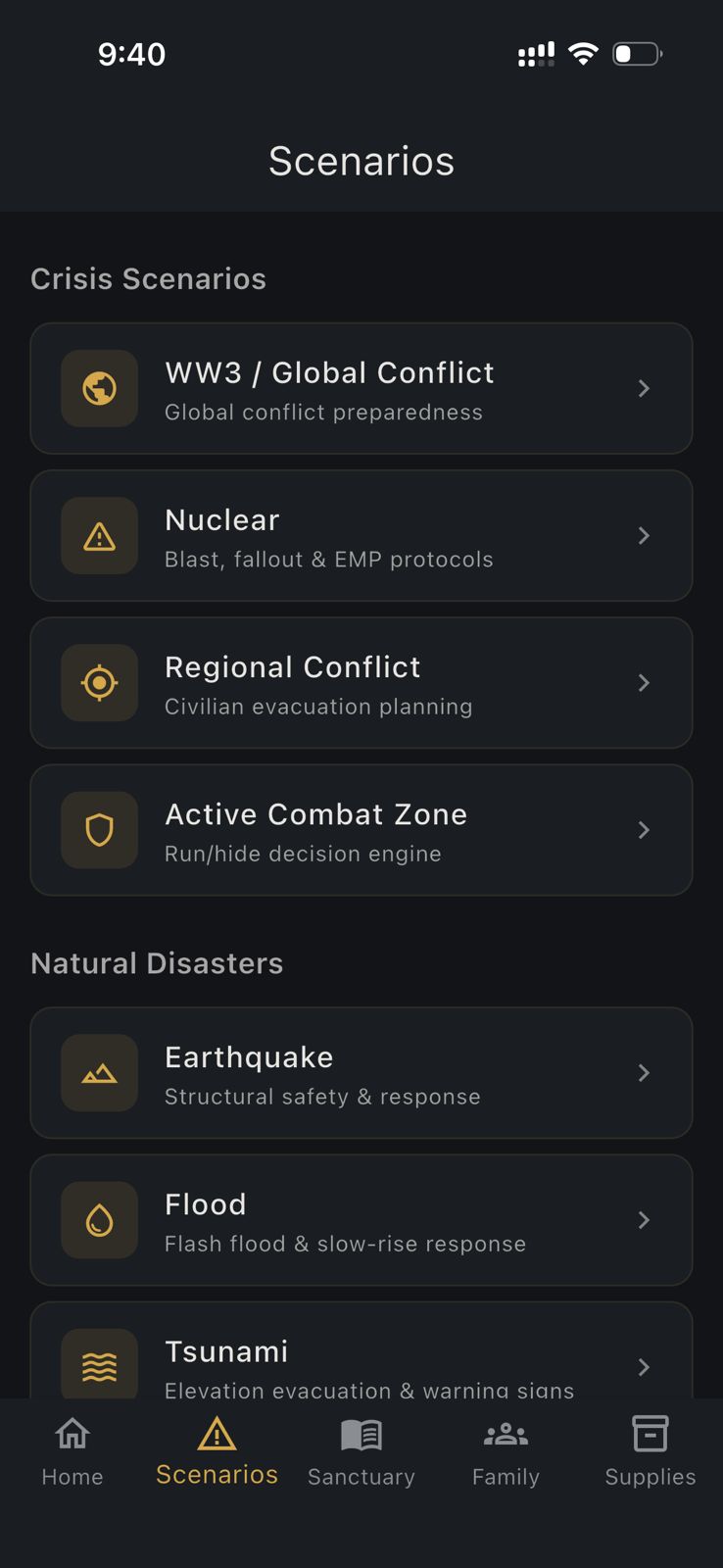
HAVEN is our app, so weigh this section accordingly. HAVEN keeps its survival guides, first aid steps and checklists on your phone, so they still work when power, Wi-Fi and mobile data do not. During a winter outage you can:
- Open the extreme cold and power outage guides offline, including frostbite and hypothermia first aid.
- Track your supplies and see how many days of water and food you actually have.
- Share your location with family and send check-ins over Bluetooth mesh when there is no signal.
Download HAVEN free and set it up while you still have power, or see everything it does offline.
The bottom line
A polar vortex disruption is a heads-up, not a guarantee. Use the warning to do the things that matter in any winter emergency: 72 hours of water, food, heat and light; a winter car kit; working CO alarms; and a family plan. Then follow your national weather service, not social media, for when and where the cold will actually hit. For the bigger picture of what governments ask households to store, see our emergency supplies by country hub.
FAQ
Q: What is the polar vortex?
A: It is a band of strong winds high in the stratosphere above the Arctic that normally keeps the coldest air near the pole. When it weakens or splits, Arctic air can move south into North America and Europe.
Q: Will the November 2026 polar vortex disruption bring extreme cold?
A: It raises the chance of Arctic outbreaks in the following weeks, usually 1 to 3 weeks after the disruption, but it does not guarantee them, and forecasters cannot yet say exactly where cold air will land. Follow your national weather service for warnings.
Q: How do I prepare for a polar vortex?
A: Have at least 72 hours of water, food you can eat cold, warm layers, torches, a charged power bank, medicines and cash. Protect pipes, test carbon monoxide alarms, keep the car tank half full with a winter kit inside, and agree a family plan.
Q: How much water should I store for a winter emergency?
A: Canada advises 2 litres per person per day, the UK 3 litres, and the US 1 gallon (about 3.8 litres). Store at least 3 days' worth for everyone in the household, plus water for pets.
Q: Is it safe to heat my home with a gas oven or barbecue in a power cut?
A: No. Gas ovens, barbecues, camping stoves and outdoor heaters produce carbon monoxide, which can kill in minutes indoors. Use layers, blankets and one warm room instead, and run generators at least 6 m (20 ft) from the house.
Ready to get prepared?
Carry on-device AI advice, offline topographic maps, and 12 printable field manuals on your phone with zero cell signal needed.