Why Are Countries Telling People to Stockpile? The 2026 List, Explained
From the UK's Be Ready checklist to Japan's new Disaster Management Agency, governments are asking households to keep emergency supplies at home. Here is why it is happening, what each country actually asks for, and whether the US is doing the same.
In just a few weeks, the UK launched its Be Ready campaign asking households to prepare for 3 days of disruption, and Japan's new Disaster Management Agency asked every home to keep at least 3 days, ideally a week, of water and food. Add Germany, Sweden, Norway, France, Canada and others, and news reports now count more than 30 governments with household stockpile advice. It is no surprise people are asking: why are countries telling people to stockpile, and do they know something we do not?
Quick answer: No government has said a specific disaster or attack is coming. Most of this advice has existed for years. What changed is that governments are now actively pushing it, after a run of real events showed how quickly power, water, payments and phone networks can fail: war in Europe and sabotage of infrastructure, cyberattacks, record storms and floods, and the April 2025 blackout across Spain and Portugal. The message is simple: if services stop, emergency teams help the most vulnerable first, so everyone else should be able to manage on their own for 3 days at minimum, and a week or more in some countries.
Why governments are asking households to prepare now
1. Infrastructure is more fragile than it looks
Modern life depends on a chain of systems that all need electricity: water pumps, card payments, mobile masts, fuel pumps and fridges. The April 2025 Iberian blackout cut power to tens of millions of people in a few seconds. A household that can last 72 hours on its own takes pressure off emergency services when it matters most.
2. Security threats in Europe
Since Russia's full-scale invasion of Ukraine in 2022, Nordic and Baltic countries in particular have updated their civil defence advice. Sweden began sending its booklet If Crisis or War Comes to every household in November 2024, and Norway raised its advice from 3 days to one week. Damage to undersea cables and pipelines in the Baltic Sea and cyberattacks on public services have made "hybrid" disruption a mainstream planning scenario.
3. Extreme weather is getting more extreme
Heatwaves, floods, wildfires and winter storms are the most common reason anyone actually uses an emergency kit. The UK's Be Ready campaign names severe weather and cyberattacks side by side, and this winter's rare, early polar vortex disruption is a timely reminder for Canada, the US, the UK and Ireland.
4. A shared European target
In March 2025, the European Commission's Preparedness Union Strategy asked EU member states to make their populations self-sufficient for at least 72 hours. That is why so many European countries refreshed their guidance at the same time.
5. Lessons from the pandemic
Covid showed how fast supply chains and shops can be overwhelmed by sudden demand. Governments now prefer that people build supplies slowly and calmly in advance, rather than panic-buying in a crisis.
Which countries are telling people to stockpile?
These are the governments whose official advice we track, with links to the agency pages. Our emergency supplies by country hub is updated whenever a government changes its advice.
Swipe sideways to compare columns
| Country | What the government asks | Full guide |
|---|---|---|
| Austria | 10 to 14 days of food and drink | Austria guide |
| Germany | Ideally 10 days, at least 3 | Germany guide |
| Sweden | At least one week | Sweden guide |
| Norway | One week (raised from 3 days in 2024) | Norway guide |
| Switzerland | About one week of food | Switzerland guide |
| Estonia | One week of food, water, medicine and cash | Estonia guide |
| Taiwan | At least 7 days at home | Taiwan guide |
| Japan | At least 3 days, ideally one week | Japan guide |
| New Zealand | At least 3 days, ideally one week | New Zealand guide |
| Australia | 3 days in most states, up to 7 in some | Australia guide |
| Latvia | 3 to 7 days | Latvia guide |
| United Kingdom | Up to 3 days of disruption (Be Ready) | United Kingdom guide |
| Canada | At least 72 hours | Canada guide |
| United States | Several days, at least 3 | United States guide |
| France | A 72-hour emergency kit | France guide |
| Netherlands | The first 72 hours | Netherlands guide |
| Belgium | At least 72 hours | Belgium guide |
| Denmark | 3 days | Denmark guide |
| Finland | At least 72 hours | Finland guide |
| Poland | At least 3 days | Poland guide |
| Lithuania | 72 hours | Lithuania guide |
| Ireland | A basic home kit (older guides said 3 days) | Ireland guide |
| South Korea | At least 3 days | South Korea guide |
| Philippines | A 72-hour Go Bag | Philippines guide |
| Singapore | A Ready Bag for evacuation | Singapore guide |
The pattern is clear: 3 days is the global minimum, and countries closest to the war in Ukraine or with long, cold winters ask for a week or more.
Why is Europe telling people to stockpile?
Europe is where the advice is most coordinated. In March 2025 the European Commission's Preparedness Union Strategy set a shared goal: every EU household should be able to manage on its own for at least 72 hours. Countries then refreshed their national guides to match, which is why so many announcements landed close together.
The countries asking for the most sit nearest the security risk or face the harshest winters. Sweden posts If Crisis or War Comes to every home and asks for a week, Norway raised its advice to a week in 2024, Germany's Notvorrat list suggests up to 10 days, and Austria asks for 10 to 14. None of them has said an attack is expected; they want a population that does not need rescuing in the first days of any disruption.
Is Canada telling people to prepare for 72 hours?
Yes, and it is not new. The Government of Canada has long asked every household to be ready to look after itself for at least 72 hours (3 days), with 2 litres of water per person per day. Searches for "Canada 3 day emergency" spike whenever that advice is in the news, but it is standing guidance, not a warning about a specific event. Our Canada 72-hour emergency kit list has the official checklist.
Why is the UK telling people to stockpile?
On 22 October 2026, the UK government launched Be Ready, the first stage of a three-year campaign. It asks households to be able to manage for up to 3 days if power, water, phones or the internet are disrupted, naming severe weather and cyberattacks as examples. The checklist covers water (3 litres per person per day for drinking), food that needs no cooking, a torch, a battery or wind-up radio, a power bank, first aid supplies, medicines and cash. It also suggests checking whether anyone in your home qualifies for the free Priority Services Register.
It is not a warning about a specific threat. Our UK Be Ready emergency kit list walks through the full checklist.
Is the US government telling people to stockpile?
There is no new federal instruction to stockpile. FEMA's long-standing advice on Ready.gov is to keep several days of supplies, including 1 gallon of water per person per day for at least 3 days. Claims online that the US has issued a new stockpile order are not accurate. Some states and cities run their own campaigns, especially in hurricane, wildfire and earthquake zones. See our US emergency supplies guide for the federal list and state guides.
Should you start stockpiling?
Yes, calmly. Every government on the list above gives the same advice: build supplies gradually, not in a panic. Panic-buying empties shelves for people who need things most.
A simple way to start:
1. This week: store 3 days of water for everyone at home (2 to 4 litres per person per day, depending on your country).
2. Next shop: add a few cans or packets you already eat, plus a manual can opener.
3. Next weekend: gather a torch, batteries, a radio, a power bank and a first aid kit in one box.
4. Then: add 7 days of prescription medicines, some cash in small notes and copies of important documents.
5. Finally: write a family emergency plan so everyone knows where to meet and how to reach each other.
Our complete emergency supply checklist covers every category, and the long-term food storage guide helps if you want to go beyond a week. Prefer paper? The free printable Quick Reference Card and Food Pack fit in a kitchen drawer.
What to store: the 72-hour minimum
Swipe sideways to compare columns
| Category | What to keep |
|---|---|
| Water | 2 to 4 L per person per day for 3 days, plus pets |
| Food | Food that needs no cooking, and a manual can opener |
| Light and power | Torch, spare batteries, charged power bank |
| Information | Battery or wind-up radio |
| Health | First aid kit and 7 days of prescription medicines |
| Money | Cash in small notes |
| Documents | Copies of IDs, insurance and medical information |
| Hygiene | Wet wipes, rubbish bags, toilet paper, period products |
| Warmth | Blankets or sleeping bags, especially in winter |
The most common reason anyone actually uses these supplies is a power cut. Our long-term power outage preparation guide covers what changes when the lights stay off for more than 3 days.
How HAVEN helps you prepare
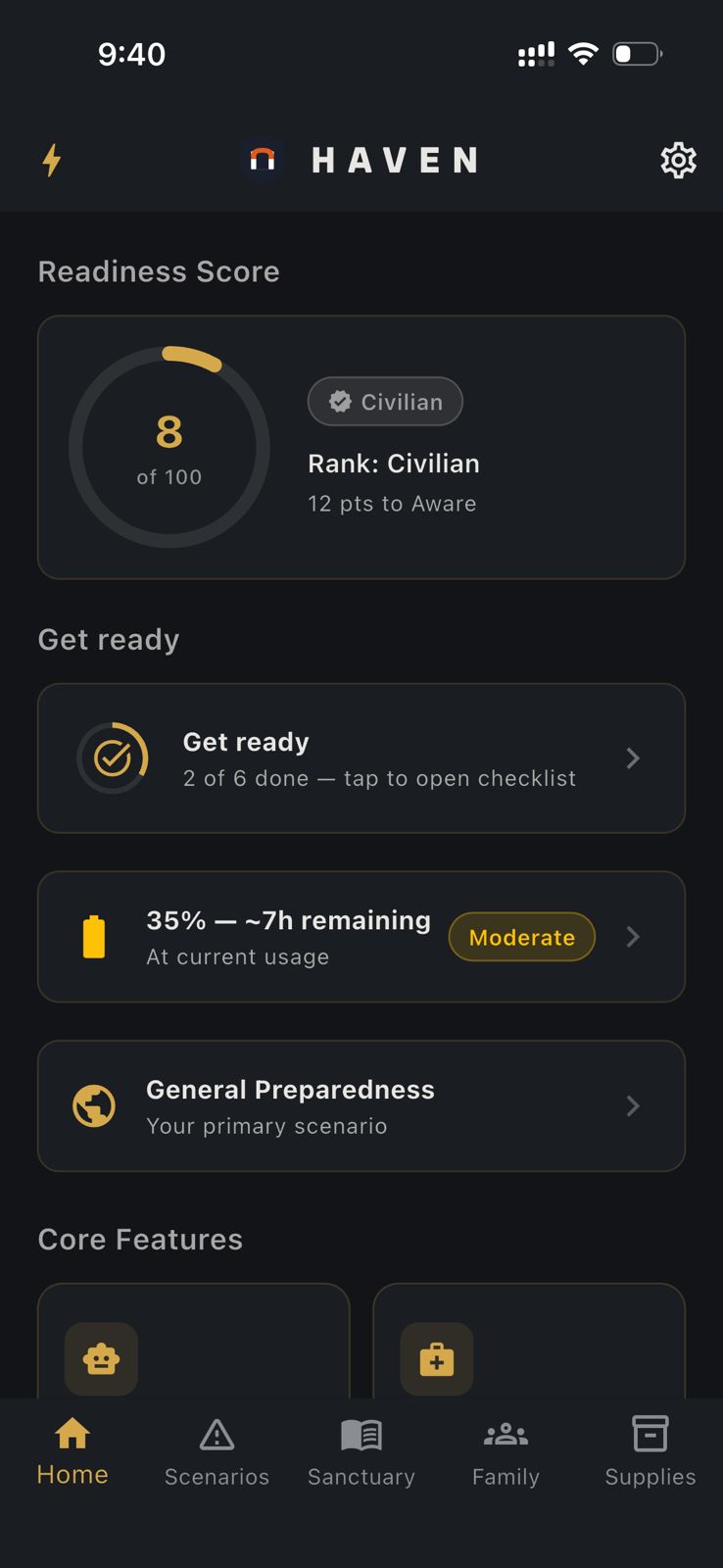
HAVEN is our app, so weigh this section accordingly. HAVEN turns your country's official advice into a checklist on your phone, tracks how many days of water and food you actually have, and keeps survival guides and first aid steps available offline when the internet is down. Download HAVEN free to set up your household kit in a few minutes, or see all features.
The bottom line
Countries are telling people to stockpile because the systems we rely on can fail suddenly, and governments would rather you were ready than reliant on help that might be stretched thin. It is not a sign that something specific is about to happen. Aim for 3 days of essentials now, build towards a week, and check your own country's advice in our emergency supplies by country hub.
FAQ
Q: Why are so many countries telling people to stockpile?
A: Governments want households to cope for at least 3 days if power, water, payments or phone networks fail, so emergency services can focus on the most vulnerable. The push follows war in Europe, infrastructure sabotage, cyberattacks, extreme weather and the April 2025 Iberian blackout, plus an EU target of 72 hours of self-sufficiency.
Q: Why are governments telling people to stockpile food?
A: Because shops, card payments and deliveries can stop for days in a blackout, storm or cyberattack. Governments ask for at least 3 days of food that keeps without a fridge and needs little or no cooking, built up gradually from things you already eat, not bought in a panic.
Q: Why is Europe telling people to stockpile?
A: The EU's March 2025 Preparedness Union Strategy asked member states to make every household self-sufficient for at least 72 hours. Nordic and Baltic countries go further, asking for a week, because of security threats since 2022 and long, cold winters.
Q: Is Canada telling people to prepare for 72 hours?
A: Yes. The Government of Canada has long asked households to be able to cope on their own for at least 72 hours (3 days), with 2 litres of water per person per day. It is standing advice, not a warning about a specific event.
Q: Does stockpile advice mean a war or disaster is coming?
A: No. None of these governments has said a specific attack or disaster is expected. Most of the advice has existed for years and is being refreshed and promoted, not issued in response to a particular threat.
Q: Is the US government telling people to stockpile?
A: There is no new federal stockpile order. FEMA's long-standing Ready.gov advice is to keep several days of supplies, including 1 gallon of water per person per day for at least 3 days.
Q: Why is the UK telling people to stockpile?
A: The UK's Be Ready campaign, launched on 22 October 2026, asks households to manage for up to 3 days if power, water, phones or the internet are disrupted, for example by severe weather or a cyberattack. It is the first stage of a three-year preparedness campaign.
Q: How many days of supplies should I keep?
A: At least 3 days (72 hours) is the minimum almost everywhere. Sweden, Norway, Switzerland, Estonia and Taiwan ask for a week, Germany suggests 10 days and Austria 10 to 14 days.
Ready to get prepared?
Carry on-device AI advice, offline topographic maps, and 12 printable field manuals on your phone with zero cell signal needed.