Bank Down? What to Do When Your Bank App and Cards Stop Working
On November 16, thousands of Chase customers couldn't log in, check balances or complete payments. It was the third straight weekday of a major US tech failure. Here's what to do when your bank goes down, and the small amount of prep that makes it a non-event.

On Monday, November 16, thousands of Chase customers suddenly couldn't log in, check their balance or finish a payment. Reports on DownDetector peaked near 5,000 in the afternoon, and Bank of America, Wells Fargo and U.S. Bank saw smaller spikes. CNN called it the third straight weekday with a massive US tech failure, after the FAA nationwide ground stop and a United Airlines outage the same day.
Quick answer: Chase said the outage came from "a software bug in on-premise hardware systems," that there was "no evidence this is cyber-related," and that operations were back to normal Monday evening. Your money was not lost. If your bank goes down again, don't retry payments over and over, screenshot what you see, use cash or a second card, and check the bank's official status page or social account. Keeping a little cash at home turns the next outage into a minor inconvenience.
What happened with Chase on November 16
- The cause: Chase blamed a software bug in its own on-site hardware, not a hack.
- What broke: Logins, balances and some transactions, online and at some branches.
- Other banks: Chase said other banks could be affected where it was part of the transaction, but that the problem was not systemic.
- The fix: Chase said transactions were posting normally by Monday evening.
What to do when your bank goes down
1. Don't keep retrying. Repeated taps can create duplicate payments that post once the system comes back. Try once, then wait.
2. Screenshot everything. Capture error messages, pending payments and your last known balance. If a charge posts twice, the screenshots help your dispute.
3. Check an official source. Use the bank's own status page or verified social account. Ignore "support" accounts that DM you. Scammers jump on outages fast.
4. Never share codes or passwords. A real bank will never ask for your one-time code or password over text, DM or a phone call you didn't start.
5. Use a backup. Cash, a card from a different bank, or a different payment app.
6. Watch for duplicates afterwards. Check your statement for the next few days and dispute anything that posted twice.
7. Bills due today? Most billers accept a short delay during a documented bank outage. Call them, and keep your screenshots.
How much cash to keep at home
Card machines, ATMs and bank apps all need power and a network. During storms and outages, cash is often the only thing that works. A simple rule:
Swipe sideways to compare columns
| Situation | How much cash |
|---|---|
| Single adult | Enough for 3 days of gas, food and medicine, about $100 to $200 |
| Family | About $200 to $500, in small bills |
| Hurricane or wildfire zone | Enough for a tank of gas, a few nights of lodging and food, if you may need to evacuate |
Keep small bills (stores may not have change), keep the cash somewhere safe and fireproof if you can, and replace what you use.
When it's more than a bank glitch
Bank outages are a reminder that everyday life runs on networks. If the power or cell network goes down too, these matter more than your balance:
- Water and food for at least 3 days, the FEMA minimum.
- Medicine: a week's supply, plus copies of prescriptions.
- Phone power: a charged power bank.
- Information you can read offline: first aid and outage guides saved on your phone, not in a browser tab.
- A family plan: a meeting point and a way to reach each other without cell service. See how to text without service.
Our November 17 blackout fact check includes a 15-minute checklist for the first 72 hours of a real outage.
How HAVEN helps
- Works with no internet. First aid, survival guides, offline maps and an on-device AI assistant run in Airplane Mode.
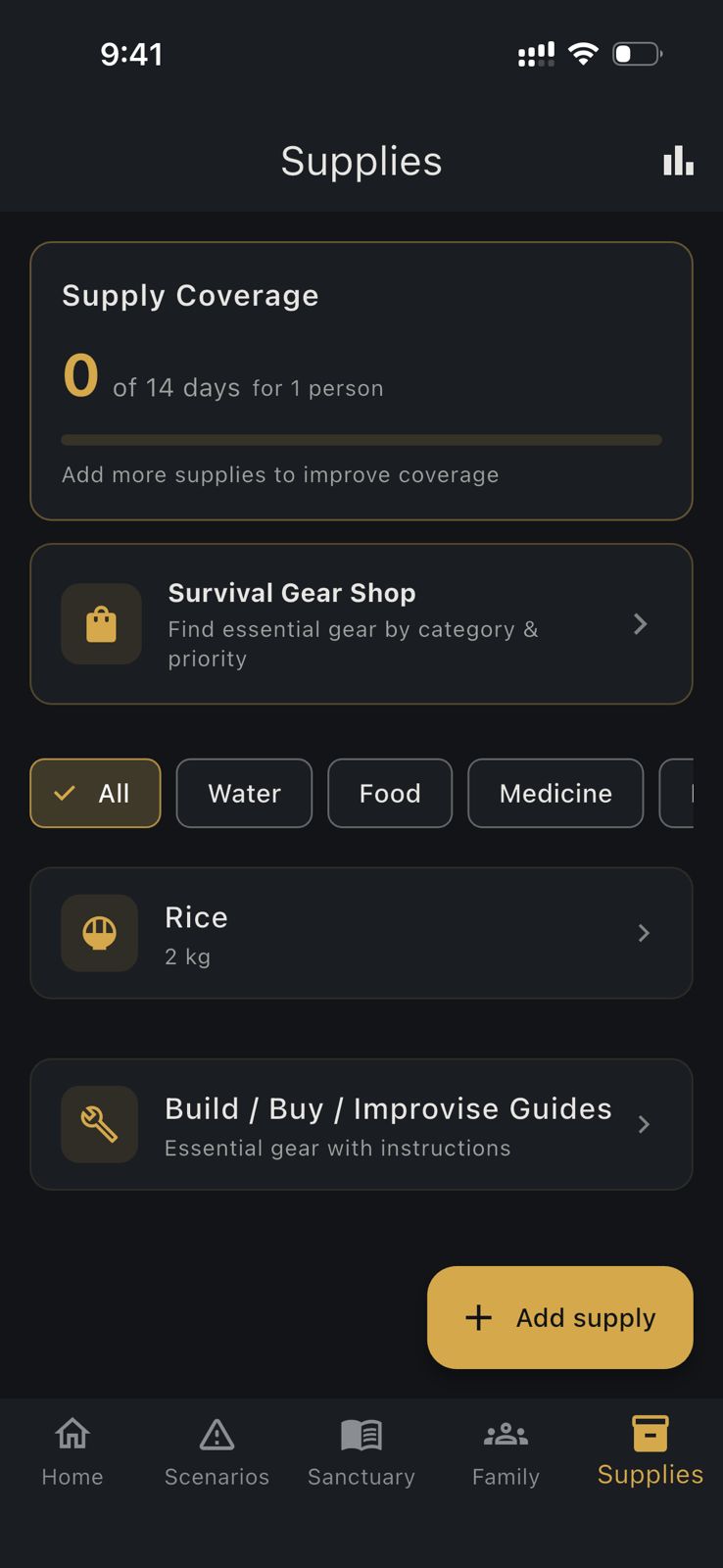
- Supplies checklist. Track water, food, medicine and emergency cash for your household.
- Messaging without the network. Nearby family phones can text over Bluetooth.
- HAVEN Watch. Follows official sources and alerts you about real events where you and your family are.
Download HAVEN free and set it up before the next outage.
FAQ
Q: Why was Chase down on November 16, 2026?
A: Chase said the outage was caused by a software bug in its on-premise hardware systems and that there was no evidence it was cyber-related. It said operations were back to normal Monday evening.
Q: Is my money safe when my bank goes down?
A: Yes. An outage stops you from seeing or moving money for a while, but it doesn't erase balances. Check your statement for duplicate charges afterwards and dispute anything that posted twice.
Q: How much cash should I keep at home for emergencies?
A: Enough for about 3 days of essentials. That's roughly $100 to $200 for one adult or $200 to $500 for a family, in small bills.
Q: What should I do if my card is declined during a bank outage?
A: Don't retry over and over, because the payments can post twice later. Pay with cash or a card from another bank, screenshot the error, and check your bank's official status page.
Ready to get prepared?
Carry on-device AI advice, offline topographic maps, and 12 printable field manuals on your phone with zero cell signal needed.